
24/7 On-Site Printing
Dedicated operators produce urgent filings, witness materials, working sets, and overnight requests.
Exhibits, binders, witness packets, scans, and urgent courtroom copies should be designed as core trial infrastructure—not improvised after the team arrives.
Plan expected daily volume, peak requests, finishing needs, file intake, approval paths, supplies, staffing, and courtroom deadlines. The production environment should be tested before counsel begins work.
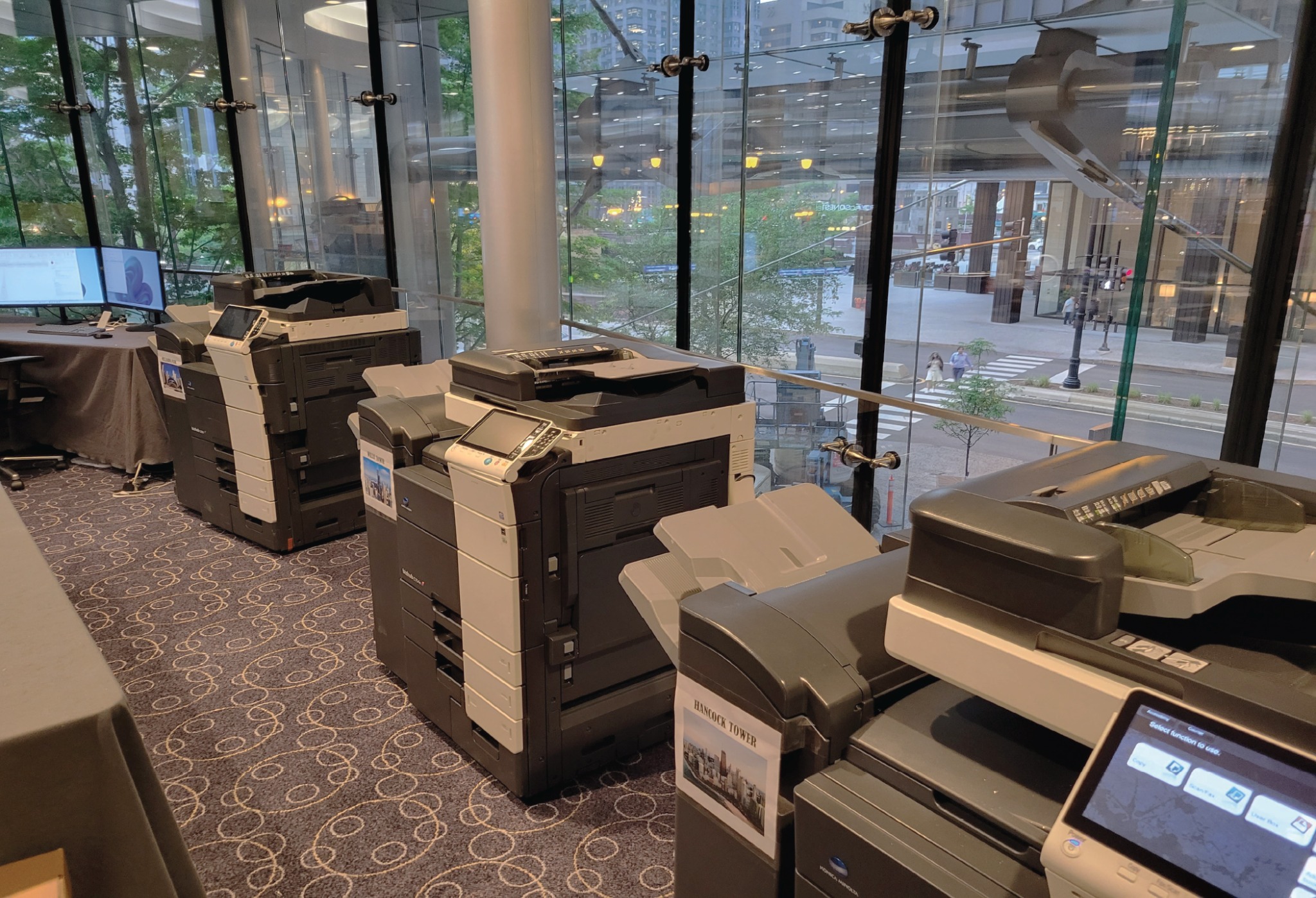
Right-size equipment, paper, toner, finishing, scanning, staffing, and backup capacity around the actual matter and schedule.
Dedicated operators produce urgent filings, witness materials, working sets, and overnight requests.
Consistent, court-ready exhibit sets produced to your specifications and delivery schedule.
Complete binder assembly, custom tabs, indexing, labels, folders, and trial organization.
Fast scanning, OCR, file conversion, secure transfer, and digital organization when needed.
Hogan monitors usage, service, consumables, and backup capacity before they become disruptions.
Paper, toner, tabs, binders, Redwelds, folders, labels, and standard production materials are included.
We scope expected volume, security, venue rules, deadlines, and redundancy.
Equipment and supplies arrive, are networked, tested, and ready before the team.
Trained Hogan personnel manage daily and overnight production through verdict.
Trial printing is the production system a legal team uses to create, organize, revise, and deliver exhibits, witness materials, binders, filings, working copies, and courtroom sets during trial.
A reliable operation requires more than placing a copier in the war room. Equipment capacity, staffing, finishing, scanning, supplies, network access, file intake, quality control, backup equipment, and courthouse delivery must work as one coordinated workflow.
Trial teams work against court schedules, changing witness orders, late exhibit revisions, and unpredictable production spikes. The print environment must handle urgent requests without sacrificing version control, confidentiality, finishing quality, or delivery timing.
Routine days can turn into large exhibit, witness-packet, or filing runs with little warning.
Clear naming, attorney approval, and quality-control steps keep superseded materials out of working and courtroom sets.
Legal, letter, 11×17, tabs, binders, hole punching, stapling, collating, folding, and saddle stitching may all be required.
Sensitive materials must move securely from approved files to the war room and courthouse on the court’s schedule.
The right model depends on whether the legal team wants to operate the equipment or needs a dedicated production team to manage intake, output, assembly, supplies, and urgent requests.
| Requirement | Copier rental | Staffed trial printing |
|---|---|---|
| Delivery, installation, and testing | Included | Included |
| Secure network configuration | Included | Included |
| Toner and standard supplies | Included | Included |
| Backup equipment | Included | Included |
| Dedicated production operator | Team-managed | Hogan-managed |
| Exhibit and binder assembly | Team-managed | Hogan-managed |
| Overnight production | Team-managed | Available with staffing |
| Courthouse delivery | Separate coordination | Can be coordinated |
Compare trial copier rental with Hogan’s 24/7 on-site trial printing service.
Start with the matter and schedule, not a device count. Scope the expected daily and peak volume, team size, exhibit calendar, paper sizes, finishing requirements, scanning needs, staffing hours, and overnight or weekend deadlines.
For larger matters, review these printing setups for large trials.
A production environment may include high-volume multifunction copiers, dedicated workstations, finishing equipment, surge protection, secure network access, and a backup copier. Evaluate pages per minute, paper capacity, duplex performance, high-speed scanning, supported paper sizes, finishing options, service coverage, and redundancy.
See the Konica Minolta C750i trial copier comparison and Hogan’s broader trial equipment rental capabilities.
The production plan should account for letter, legal, 11×17, color and specialty paper; toner; custom tabs; binders; Redwelds; folders; labels; exhibit stickers; and finishing supplies. Assign responsibility for monitoring inventory, replenishing consumables, assembling sets, and staging completed materials.
Define approved production folders, file-naming rules, version-control practices, attorney approval steps, secure transfer methods, network permissions, and quality checks before the first request. Sensitive material should remain within a controlled workflow, with superseded copies returned or destroyed according to the legal team’s instructions.
Coordinate these controls with the secure war-room network and the matter’s document-handling requirements.
Redundancy is more than a spare machine. The plan should include a backup copier on site, additional toner and paper, alternate production paths, spare finishing capacity, seven-day service coverage, escalation contacts, backup connectivity, and a delivery contingency.
Completed materials still need final approval, assembly, quality control, secure staging, and timely delivery. Plan scheduled court runs and an urgent-delivery path before proceedings begin. Hogan can coordinate courthouse delivery and daily runs as well as secure trial materials transport.
When the city, dates, team size, venue, and production requirements are known, request a coordinated trial printing plan.
No. Hogan supplies, installs, tests, stocks, monitors, and supports the equipment, with trained on-site personnel available to run production.
Yes. Staffing is planned around the trial schedule, including nights, weekends, urgent filings, and early courtroom deadlines.
Standard paper, toner, tabs, binders, Redwelds, folders, labels, and other ordinary production supplies are included in the managed operation.
Yes. Hogan can coordinate pretrial production, delivery, assembly, and on-site replenishment based on counsel’s schedule and specifications.
Equipment is monitored and redundancy is planned in advance. Hogan coordinates rapid service or replacement so production can continue.
Yes. Hogan can coordinate secure, time-sensitive delivery between the war room, courtroom, hotel, and other approved locations.